Using videos to spend more meaningful time with students
By Dan Spencer
At my school, I am the “physics department.”
Since we are only able able to offer one level of physics for students, I always end up with a very wide range of abilities in my classes.
For example, one year I had a student who was a National Merit Scholar trying to figure out whether he wanted to go to Duke or MIT and major in physics sitting right next to a student who was taking physics as a last chance to earn a math credit and graduate on time.
Physics can be taught in an engaging way at many different levels. . . but it is also a difficult subject to teach when students in the same classroom are at all different levels.
I am always asking myself, “Do my students really understand? Are all my students learning?”
I know that the best way to assess learning is to sit next to them, shoulder-to-shoulder, and talk about what they are doing, but who has the time?
I needed a way to see if my students really understand.
Finding time to work one on one with all my students is one of my biggest difficulties. I want to them ownership over their own learning, but a number of them have been “spoon fed” content for years and struggle to know what to do when they are given time to learn independently.
This is especially problematic due to recent changes in how we teach science.
In the past we worked from a long list of standards, checking off each item as we moved throughout the school year. Today, the Michigan Science Standards are based closely on the Next Generation Science Standards (NGSS).
These new standards have a very different focus than the long list of HSCEs we were used to teaching for so many years. NGSS is student-driven and focuses on students diving deeply into concepts from a variety of disciplines.
It’s my dream is to have a classroom that feels like a Starbucks with students spread all over the room, engaging in a variety of activities, working in a group on a lab, or working solo on an assignment.
But how do you make this type of independent learning a reality?
For me, the answer was the camera on my phone. I know, nothing fancy, no bells or whistles, just my camera. Thanks to the work shared by Ben Rimes, the power of the camera allows me to be in multiple places at once.
How?
Instead of lecturing to an entire class of students, I can create small videos of the content that students can access as needed.
Instead of giving a pre-lab to an entire class, I can give them a video introduction and meet with groups of students to make sure they really understand before doing the lab.
Instead of answering the same question five times during a class period, I can post examples of me working through problems I know they will have.
Instead of having students turn in papers I know I’m going to struggle to grade, I can have them do a one-minute video explanation working through a problem and get a much better grasp of what they do and do not understand.
Here are just a few examples of how I have used videos in my classroom:
- Video “story problems” — Floating and sinking oranges
- Concept videos — Force Diagrams with Components
- Hooks — The Rivalry or 5 meter Challenge
- Lab/Experiment intros — Dissolving Sugar or The Metric Recipe Challenge
- Recording class for absent students — Example
- Demonstrations — Tablecloth Inertia or Flaming Bubbles
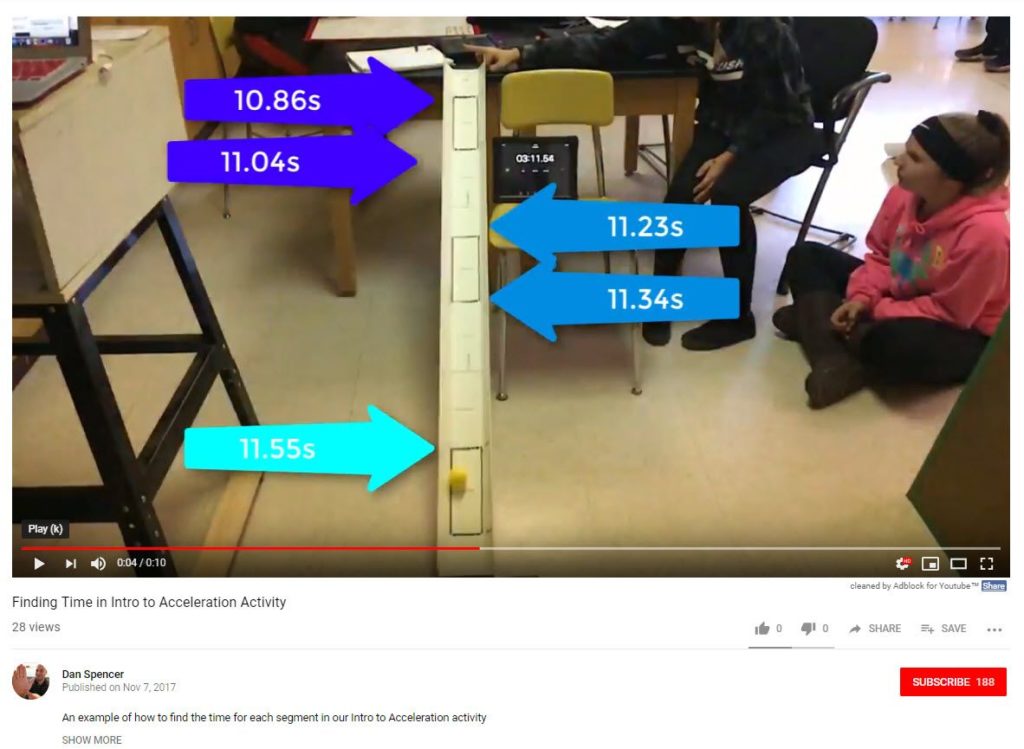
- Student explanations — Position, Distance, and Displacement or Food Coloring in Different Temperatures of Water
- Student presentations — Make a Musical Instrument (Glockenspeil)
Now, you may be wondering, “Who has time to make all these videos?!”
But making videos is the easy part. In fact, I really enjoy it now that I’m comfortable with it and I keep finding new ways to use them. While I’m not against using videos from other teachers, I feel my students respond better when it’s my face and voice on the video.
The hardest part is helping students get used to being in charge of their learning. Since my students can access those videos any time, the most important thing that happens in my classroom is checking on my students every day.
I can ask them what questions they have. I can ask them to show me how they did a problem. I can talk to them about the basketball game, the band concert, or why they look so tired.
Truthfully, the videos are just an avenue for me to spend more meaningful time with my students, which is really what every student needs.