Innovation in Education

Students have access to more information in their pockets than ever before, yet they are often told to leave their phones in their lockers.
Facebook
LinkedIn
X/Twitter
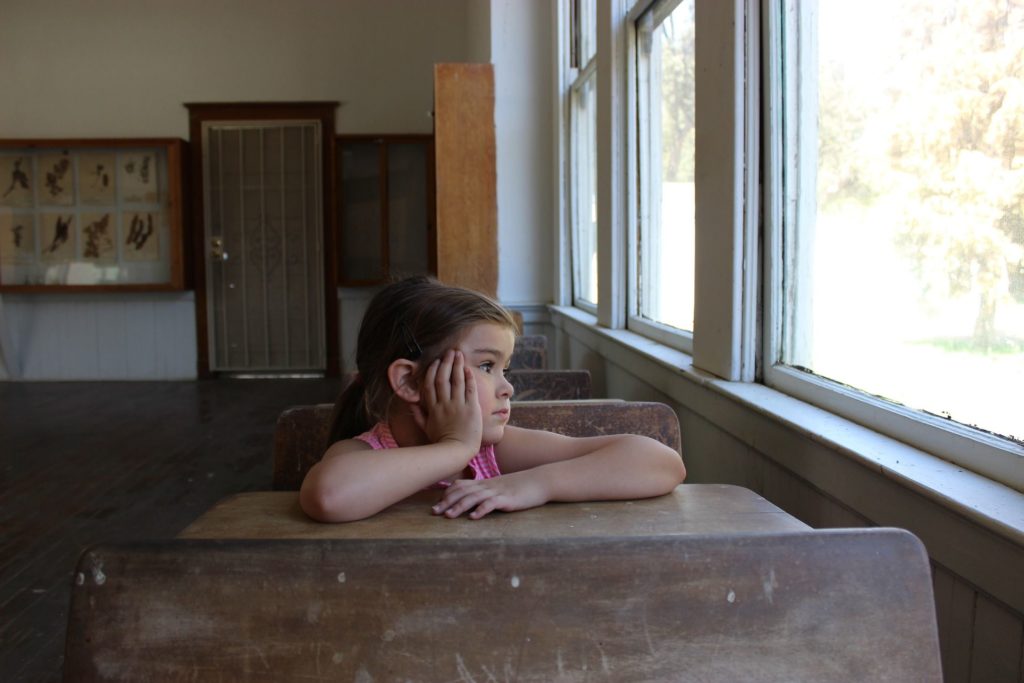
Child staring out a window in a classroom

This article was originally posted at Passing Notes and is the first in a series for a MOOC on The Innovator’s Mindset #IMMOOC by George Couros.

Imagine if a student today time-traveled to the classroom of 1917.  Our time-traveling student would be out of place culturally, and yet the classroom itself might not be terribly different.  In the classrooms of 2017, chalkboards have been replaced by whiteboards, overhead projectors by LCD projectors or even some type of SMART board, but are students still sitting in rows and turning in worksheets?   Or they creating, producing, and collaborating?

When one of my own kids brought home a classroom syllabus from school, I felt deflated as I read it.  The paper looked as if it had been typed — on a typewriter — decades ago.  The teacher had scribbled out percentages on the paper and handwritten over them before sending it through the copy machine.  Students will complete 30 homework problems each night (with the answers in the back of the book) — not exactly engaging, transformative, or innovative.  I have difficulty imagining that the students in this classroom are inspired to learn more on their own or are looking forward to another day of lectures, rows, and drilled practice.

In the introduction of The Innovator’s Mindset, George Couros (@gcouros) writes,

We forget that our responsibility isn’t solely to teach memorization or the mechanics of a task but to spark a curiosity that empowers students to learn on their own.

To wonder.
To explore.
To become leaders.

We forget that if students leave school less curious than when they started, we have failed them.

Why is it so difficult to innovate in education today?  Students have access to more information in their pockets than I had in an entire school library, yet they are often told to leave their phones in their lockers, or they’re blocked by school firewalls on all kinds of websites.

While some teachers become early innovators in their buildings, it’s rare to see an entire building of innovators.  One key difference between a handful of innovators and an entire system that values innovation lies in leadership.  Innovative leadership is still uncommon in the world of education.  After leaving the face-to-face classroom to work as a lead instructor at Michigan Virtual, my new supervisor told me, “I see my job as being the person to remove barriers for our teachers.”  I thought she was messing with me.  I’m sure I looked highly skeptical after years of feeling roadblocked in a large public school system.  But she was true to her philosophy, and it’s a philosophy I keep at the forefront as I now lead teachers within our organization.

What would be possible for classroom teachers if all school leaders took the approach of removing barriers for their teachers?  How would that ultimately change a classroom experience for students?

Facebook
LinkedIn
X/Twitter
Picture of Andrea McKay

Andrea McKay

As an educational leader and learner, Andrea has taught in many environments - face-to-face, blended/hybrid, and fully online. Andrea currently serves as the Director of Instruction, a position that allows her to support and empower an incredible team of teachers who teach online students all over Michigan. Andrea is inspired to work for a non-profit organization where so many employees are impassioned to create positive change in learning and education. One of her key values is ‘making a difference,’ and Michigan Virtual has given her the opportunity to do so for teachers and students around the state.

You might also like...

Top-down View of Children in Classroom Use Tablets and Laptops, Connectivity by Lines of AI Data, Information. Diverse Kids Study with Interactive E-Learning, Modern Education, Digital Literacy

Have You Considered AI in Your Classroom? A Khanmigo Pilot Story

In a two-phase pilot across Michigan schools, educators used Khanmigo, an AI-powered tutor and teaching assistant, to explore how AI might support teaching and learning. Their reflections surfaced both opportunities and challenges. The big takeaway?...
Psychological concept of choices and Finding or Choosing the right life path with group of diverse people following intersecting paths to doors with central signpost on arrow, flat vector illustration

Out of Order, Still Out of Reach: Variations in Pacing among World Language Students

Cuccolo & Green’s (2025) report highlighted the relationship between students’ assignment submission patterns and final course scores. Given that pacing has important implications for student performance, knowing what assignment submission patterns look like across schools...
Illustration of three people using virtual reality (VR) headsets. Each person is interacting with a colorful, cosmic-themed environment featuring abstract planets, stars, and orbits. One person points at a floating circle, another raises their hand toward an orange sphere, and the third holds VR controllers, immersed in the experience. The background features deep purples, blues, and greens with celestial shapes like the moon and stars.

From Curiosity to Career: Exploring Possibilities with VR

Explore how immersive VR simulations helped students step into real-world roles: from EMTs to chefs, all without leaving the classroom....
A cheerful classroom scene with elementary-aged students working on laptops. A smiling boy in the foreground looks directly at the camera, while other students and a teacher engage in learning activities in the background. The classroom is softly lit, with large windows and warm yellow curtains.

The AI Horizon: Case Studies in Michigan Education’s Transformation (Part 2)

The work to integrate artificial intelligence in Michigan schools is gaining momentum. In Part 1 of this series, we looked at how four districts are building their own foundations through task forces, learning councils, and...

A classroom scene where a diverse group of elementary-aged students work on laptops at their desks. A smiling teacher leans over to assist one student, creating an engaging and supportive learning environment. Sunlight streams through large windows with yellow curtains in the background.

The AI Horizon: Case Studies in Michigan Education’s Transformation (Part 1)

The integration of Artificial Intelligence (AI) is rapidly shifting the landscape of education, presenting both unprecedented opportunities and novel challenges for K-12 institutions. Across Michigan, a wave of innovation is taking shape as K-12 schools,...

Two coworkers discussing work over lunch outside their office building while on a break

Mastering Change: Coaching as the Lever for Transformation in Education

Originally published in the Spring 2025 issue of the MASB Leaderboard Magazine. Introduction A few years ago, I came across Master of Change by Brad Stulberg, and it couldn’t have landed at a more fitting...

The Digital Backpack

Get our latest articles sent straight to your inbox every week!