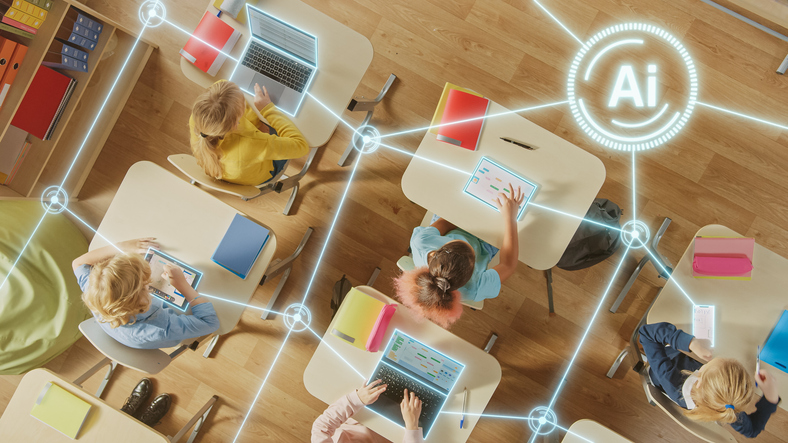

The conversation around AI in the classroom often begins with its capacity to streamline administrative tasks and automate some teaching responsibilities, highlighting the potential for them to help teachers spend their time on more important and productive work. This may certainly be a worthwhile advantage of AI adoption (although the research to determine just how large the benefits may be is still in process). However, the true value of AI in teaching and learning extends far beyond mere time-saving benefits. By focusing solely on efficiency, we risk overlooking AI’s profound potential to enrich educational experiences, foster deeper understanding, and cultivate critical thinking skills among students. This broader perspective invites educators to leverage AI not just as a tool for doing things faster but as a means for doing things better.
Navigating beyond efficiency
Incorporating AI into educational practices with aims that go beyond efficiency requires a thoughtful and critical approach. The Triple E Framework, proposed by Dr. Liz Kolb, provides a valuable lens for evaluating technology’s impact on teaching and learning. This framework assesses technology based on its ability to engage students, enhance learning objectives, and extend students’ cognitive and social abilities. By applying such criteria to AI tools, educators can make informed decisions about which technologies genuinely contribute to learning enhancement. The following examples are ones that teachers might explore through the lens of the Tripe E framework to determine how AI might enhance their teaching practices and produce positive tangible outcomes.
Practical application
Since generative AI tools can produce endless amounts of content, including text and images, teachers can use them to rapidly produce tailored educational content that aligns with their students’ learning needs and interests. Many tools, including ChatGPT, MagicSchool, and others allow for generating personalized reading materials, worksheets, or problem sets that cater to different learning levels within a single classroom. Some tools even include intuitive features that produce content aligned to specific content standards. This functionality has the potential to not only more easily support differentiated instruction but also help address the diverse needs of students, making learning more accessible and engaging for everyone.
Generative AI tools can also be used to provide personalized feedback on student assignments, offering constructive and timely insights that can help students improve their work products through iteration. The current state of large language models does not allow for rigorous, consistent, and valid assessment, but they can certainly be of help in formative assessment practices that build learners’ skills and competencies. ChatGPT and other more purpose-built tools like Brisk can be used for this purpose, which not only helps reduce the feedback workload for teachers but also provides students with individualized guidance to support their academic growth.
Furthermore, AI can empower educators to be innovative in their teaching methods. One of the core appeals of generative AI is that it allows users to create things without the need for technical expertise, such as knowledge of coding languages. With a smaller learning curve, teachers could, for example, create AI-generated simulations, role-playing games, or visual aids that illustrate and make relevant standard-specific content in vivid detail, making abstract concepts tangible. This not only aids comprehension but could also inspire creativity among students, encouraging them to explore and express their understanding in novel ways.
Critical evaluation for enhanced learning
While plenty of tool makers will have sales pitches that include the capacity to streamline tasks and enhance efficiency, generative AI’s real potential lies in its ability to transform educational experiences. Through exploring and experimenting with AI, educators have the opportunity to not only save time but also find ways to enrich teaching and learning processes in profound ways. As research continues to help identify the benefits and best practices of AI in education, it is imperative for educators to critically evaluate these technologies and approach them with intentionality. By doing so, they can avoid having AI perpetuate rote teaching practices and instead create more inclusive, engaging, and effective learning environments.
Dive deeper into AI’s practical applications
Our resource guide empowers you to seamlessly integrate and explore AI tools for your classroom. Take the next step in transforming your educational approach.
Explore AI Resources